

How to Plan a Travel Itinerary Without Getting Exhausted
Planning a trip is exciting until your itinerary starts looking like a military schedule.
Wake up at 6 AM. Visit three places before lunch. Cross the city for another attraction. Find a restaurant. Catch a sunset. Pack your bags. Repeat.
It may look like you’re getting the most out of your holiday. In reality, you may spend more time watching the clock than enjoying the destination.
The best travel itinerary isn’t the one that fits in the most activities. It’s the one that gives you enough time to actually enjoy them.
A comfortable itinerary leaves room for travel, meals, unexpected delays, rest and simply doing nothing for a while.
Here are some trip planning tips that would let you enjoy without turning your holiday into a race.
What Makes a Travel Itinerary Exhausting?
An itinerary becomes exhausting when every hour is already accounted for.
The problem isn’t necessarily having a long list of places to visit. It’s putting too many things together without considering how long the day will actually take.
For example, an itinerary might say:
9:00 AM: Breakfast
10:00 AM: Attraction 1
12:00 PM: Attraction 2
2:00 PM: Lunch
3:00 PM: Shopping
5:00 PM: Viewpoint
7:00 PM: Dinner
On paper, it looks manageable.
But where is the time for traffic, parking, finding the entrance, waiting in queues, taking photos, using the washroom or simply sitting down?
Those small gaps are what turn a relaxed day into a tiring one. Here’s how to plan a travel itinerary considering different aspects for a relaxing holiday.

1. Stop Treating Travel Time as Free Time
This is one of the biggest itinerary mistakes.
If Google Maps says a place is 45 minutes away, that doesn’t mean your activity starts 45 minutes after you leave.
You may need time to:
- Find a cab or auto
- Walk from the parking area
- Find the correct entrance
- Deal with traffic
- Look for a washroom
- Store your belongings
- Find your way around
And if you’re using public transport, there may also be waiting time and connections.
So when planning your day, think about door-to-door time, not just the estimated driving time.
A simple rule
If an activity is listed as taking one hour, don’t automatically give it exactly one hour in your itinerary.
Give yourself some breathing room around it.
You don’t need to calculate every minute. Just stop assuming everything will happen exactly on schedule.
2. Don’t Turn Your Arrival Day Into a Sightseeing Marathon
Your arrival day is not a normal day.
Even if your train or flight arrives in the morning, you still have to:
- Reach your accommodation
- Check in or leave your luggage
- Freshen up
- Eat
- Get familiar with the area
If you’re travelling by train, the journey itself may have taken several hours.
So don’t immediately plan six sightseeing spots for the same day.
Instead, choose one or two easy activities close to where you’re staying.
Think of the first day as a transition into the holiday.
You don’t have to prove that the trip was worth it within the first six hours.
3. How Many Activities Per Day Should You Plan for a Trip?
There is no magic number that works for everyone.
But a useful approach is to divide activities into three categories:
Must-do
These are the places you would genuinely regret missing.
Nice-to-do
You’d enjoy them, but missing them wouldn’t ruin the trip.
If-we-have-time
These are optional extras.
Now build your day around the must-do activities first.
Add one or two nice-to-do activities if they fit naturally along the route.
Keep the third category flexible.
This prevents your entire trip from depending on everything going perfectly.
Remember:
Three enjoyable places are better than seven places you barely remember.

4. Leave Space Between Activities
Don’t schedule your next activity immediately after the previous one ends.
Give yourself some breathing room.
You might want to:
- Sit at a café
- Take photographs
- Browse a local shop
- Rest at the hotel
- Have a slow lunch
- Walk around without a specific destination
These moments may not appear in your itinerary.
But they are often the moments you remember.
A holiday doesn’t need to be productive.
5. Stop Changing Hotels Every Night
Moving between hotels can quietly consume a large part of your trip.
You have to:
- Pack everything.
- Check out.
- Travel to the next area.
- Find the new accommodation.
- Check in.
- Unpack again.
If you’re travelling for only a few days, changing hotels repeatedly may not be worth it.
Of course, there are trips where changing locations makes perfect sense.
But before adding another hotel, ask:
Will staying here actually give me enough extra experience to justify moving?
Sometimes staying in one well-connected area is much more relaxing.
6. Plan Your Route, Not Just Your Attractions
This is where a map becomes more useful than a long list of recommendations.
Suppose you want to visit five places.
Don’t simply arrange them based on popularity.
Look at where they are.
If three attractions are close to each other, visit them together.
Then plan another part of the city on another day.
This reduces unnecessary back-and-forth travel.
Think in neighbourhoods
Instead of:
Place A → Place B → Place C → Place A → Place D
Try:
Area 1 → Area 1 → Area 1
Then:
Area 2 → Area 2 → Area 2
You’re not necessarily doing fewer things.
You’re simply spending less time getting between them.

7. Don’t Forget Meals, Rest and Getting Ready
A common itinerary mistake is forgetting that travellers are actual humans.
You need time to:
- Wake up
- Shower
- Get dressed
- Have breakfast
- Find lunch
- Have dinner
- Take breaks
If you’re travelling with family or friends, these things can take even longer.
And that’s okay.
For many travellers, getting ready for the day can easily take an hour or more.
Don’t start your itinerary at 7 AM just because the attraction opens at 8 AM.
Ask yourself whether you actually want to wake up that early while on holiday.
8. Build a Buffer Into Your Itinerary
Something will probably go wrong.
Your train may be delayed.
Traffic may be worse than expected.
A restaurant may have a long queue.
You may spend an extra hour somewhere because you’re enjoying yourself.
That’s normal travel.
Your itinerary should have enough flexibility to absorb small delays.
A good way to do this is to avoid scheduling important activities back-to-back.
If missing one activity means the entire day’s plan collapses, the schedule is probably too tight.
9. Give Yourself a “Nothing” Window
This might be the most underrated travel planning tip.
Leave a few hours with nothing planned.
Not “free time to squeeze in another attraction.”
Actual free time.
You could:
- Sleep
- Read
- Sit at a café
- Explore nearby streets
- Spend time at your hotel
- Watch the sunset
- Take a slow walk
- Do absolutely nothing
This is especially valuable on longer trips.
You don’t need to come home with a photograph from every hour of your holiday.
How to Tell If Your Itinerary Is Too Packed
Before finalising your trip, ask yourself these questions:
- Have I planned something for almost every hour?
- Am I travelling across the city multiple times in one day?
- Have I included travel time between attractions?
- Have I allowed enough time for meals?
- Is my arrival day overloaded?
- Am I changing hotels more than necessary?
- Have I left any free time?
- Would a small delay ruin the rest of the day?
- Am I including places simply because they are popular?
- Do I actually want to visit everything on this list?
If you answer yes to several of these, your itinerary probably needs some breathing room.
Before vs. After: Turning an Exhausting Itinerary Into a Comfortable One
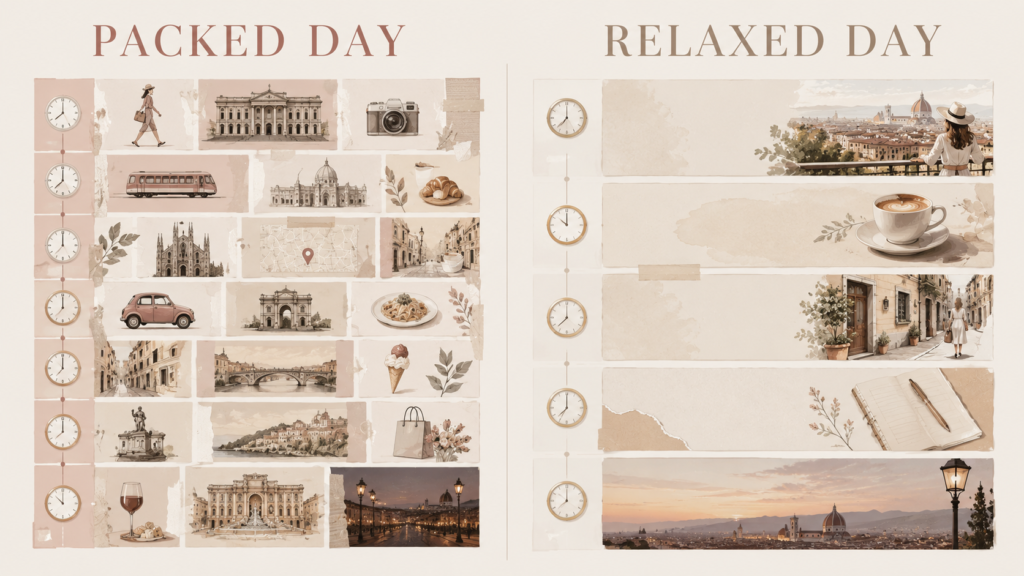
Let’s take a simple example.
The packed version
8 AM: Breakfast
9 AM: Attraction A
10:30 AM: Attraction B
12 PM: Attraction C
1:30 PM: Lunch
2:30 PM: Shopping
4 PM: Attraction D
6 PM: Viewpoint
8 PM: Dinner
It looks productive.
It also leaves very little room for reality.
The relaxed version
8:30 AM: Breakfast
10 AM: Attraction A
12 PM: Nearby attraction B
2 PM: Lunch and break
4 PM: Free time
5:30 PM: Viewpoint
7:30 PM: Dinner
You’ve removed two or three activities.
But you may actually enjoy the remaining ones more.
That’s the point.
A good itinerary isn’t about seeing everything. It’s about making the things you choose worth your time.
A Simple Way to Build a Comfortable Travel Itinerary
When you’re starting from scratch, try this order:
Step 1: Write down everything you want to see
Don’t organise it yet.
Just make the list.
Step 2: Mark your absolute priorities
Choose the places you would genuinely be disappointed to miss.
Step 3: Put them on a map
Look for attractions that are close together.
Step 4: Group nearby places
Create rough neighbourhood or area-based groups.
Step 5: Account for travel time
Use realistic door-to-door estimates.
Step 6: Add meals and breaks
Don’t treat them as empty spaces.
They are part of the day.
Step 7: Keep some activities optional
Your itinerary should be able to survive a change of plan.
Step 8: Add free time
Leave at least one part of the day flexible when possible.
Step 9: Review the whole trip
Read the itinerary as if you were actually living it.
Would you enjoy this schedule?
Or would you need a holiday after the holiday?
Is a Slower Itinerary Better?
Not necessarily.
A slower itinerary isn’t automatically a better itinerary.
Some travellers genuinely enjoy busy days. Others prefer long breakfasts and unplanned afternoons.
The goal isn’t to travel slowly just because slow travel sounds fashionable.
The goal is to create an itinerary that matches your energy, interests and travel style.
If you love museums, you may happily spend an entire afternoon inside one.
If you prefer exploring outdoors, you may want fewer scheduled stops and more time walking around.
There is no perfect itinerary.
There is only an itinerary that works for you.

Frequently Asked Questions
How many activities should I plan in one day?
There is no fixed number. Start with your must-see activities, group places that are close together and leave time for travel, meals and unexpected delays.
Should I plan sightseeing on my arrival day?
You can, but keep it light. Arrival, check-in, meals and travel can take more time and energy than expected.
How much free time should I leave in a travel itinerary?
Enough that a small delay doesn’t ruin the rest of your day. You can also deliberately leave a few hours completely unplanned.
Is it better to stay in one hotel or change hotels?
For shorter trips, staying in one well-located hotel can often be more convenient. Changing hotels makes more sense when it significantly improves access to different parts of your trip.
How do I know if my itinerary is too packed?
If your schedule has back-to-back activities, long cross-city journeys, little meal or rest time and no flexibility, it is probably too packed.
What is the best way to plan a travel itinerary?
Start with your priorities, group nearby places, estimate realistic travel time, add meals and breaks, and leave some activities flexible.
Final Thoughts
A travel itinerary should help you enjoy your holiday.
It shouldn’t make you feel like you’re working through a checklist.
You don’t need to wake up before sunrise every morning. You don’t need to visit every attraction. And you certainly don’t need to fill every empty hour.
Leave room for a slow breakfast.
Take the longer walk.
Sit at that café for another 20 minutes.
Stay at a place because you’re enjoying it instead of leaving because your itinerary says it’s time.
The best trips aren’t necessarily the ones where you see the most. They’re the ones where you actually have time to enjoy what you came to see.
And if your itinerary looks perfect on paper but leaves you exhausted just reading it, that’s probably your first sign that it needs editing.