Why Does My Hair Look Good at Home and Frizzy the Moment I Step Outside?
You finish getting ready, check your hair in the mirror, and everything looks right. The blowout is smooth. Your part is sitting exactly where you want it. The ends are behaving. Even the tiny hairs around your face seem unusually cooperative.
Then you leave the apartment.
By the time you reach the train, walk two blocks to work, or meet a friend for coffee, your hair has expanded, curled around your temples, lost its smooth finish, or developed a halo of flyaways.
So why does your hair look good at home and frizzy the moment you step outside?
Quick Answer: Why Does Hair Get Frizzy Outside?
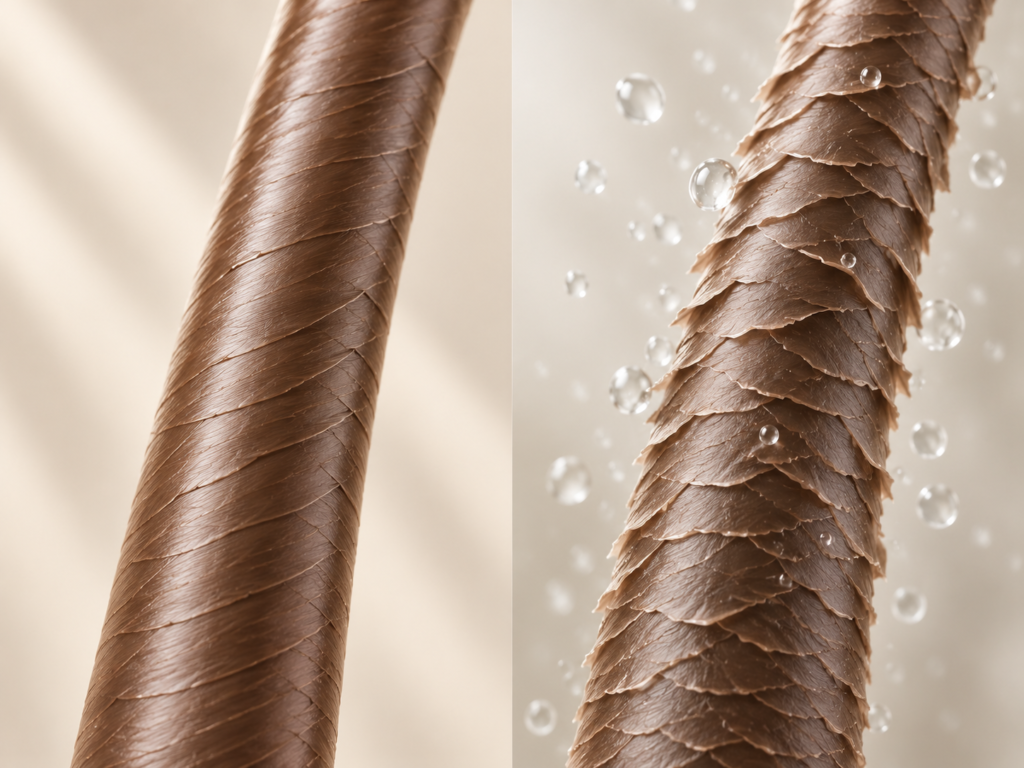
Hair often becomes frizzy outdoors because it responds to moisture in the air. In humid conditions, hair can absorb water from its surroundings. That moisture affects temporary hydrogen bonds within the keratin structure of the hair, which can cause strands to swell, bend, curl, or move away from the shape you created while styling.
But humidity is only part of the story.
How porous your hair is, how much heat or chemical processing it has experienced, the products you used that morning, sweat, wind, friction, and even the difference between your indoor and outdoor environments can all affect how quickly your style changes.
Understanding those factors is much more useful than simply buying another bottle labeled “anti-frizz.”
Your Room Is a Controlled Environment. The Street Isn’t.
One of the most overlooked explanations for sudden outdoor frizz has nothing to do with your styling skills.
Your home is relatively controlled.
You may have air conditioning running. There is little wind. You are not sweating. Your hair is not rubbing against a coat collar, scarf, tote bag, or jacket. You are also standing still while checking the finished result.
Then you walk outside and expose your hair to an entirely different environment.
There may be humid air, wind, heat rising from the sidewalk, light rain, subway platforms, crowded buses, perspiration around your scalp, or the constant friction of moving through the city.
Your hair has not suddenly “gone bad.” The conditions around it have changed.
That distinction matters because a hairstyle that looks perfect in a climate-controlled bedroom may not have been prepared to hold its shape through a humid commute.
For urban women in particular, hair has to survive much more than the ten minutes between styling and looking in the mirror. It has to survive the walk to the station, a warm subway car, an air-conditioned office, lunchtime outside, another commute, and perhaps dinner or drinks afterward.
A realistic hair routine needs to account for all of those environments.
What Does Humidity Actually Do to Your Hair?
Hair is made primarily from a protein called keratin.
Within the hair fiber are different types of chemical bonds. Some contribute to your more permanent natural hair structure, while weaker hydrogen bonds can change when hair becomes wet and reform as it dries. That is one reason water and heat can temporarily reshape the hair.
When the air contains a lot of moisture, hair can take up some of that water.
As the fiber absorbs moisture, the temporary arrangement created during blow-drying, straightening, or styling can begin to shift. A sleek strand may start returning toward its natural wave or curl pattern. Different sections may respond at slightly different rates, which creates the uneven texture we recognize as frizz.
This also explains why humidity does not affect everyone’s hair in exactly the same way.
Straight hair might develop flyaways or puffiness.
Wavy hair may become fuller or lose definition.
Curly hair may shrink, expand, or develop less-defined curls.
Hair that has been straightened may begin bending around the hairline first, where heat and perspiration can have the greatest impact.
Frizz is not one specific hair type. It is a visible response to how individual strands interact with moisture, condition, texture, and the surrounding environment.
Why Does Humidity Affect Some Hair More Than Others?
If your friend can walk through humid weather without changing her hairstyle while yours seems to react before you have reached the end of the block, hair porosity may be part of the explanation.
Porosity describes, broadly, how readily hair takes in and releases moisture.
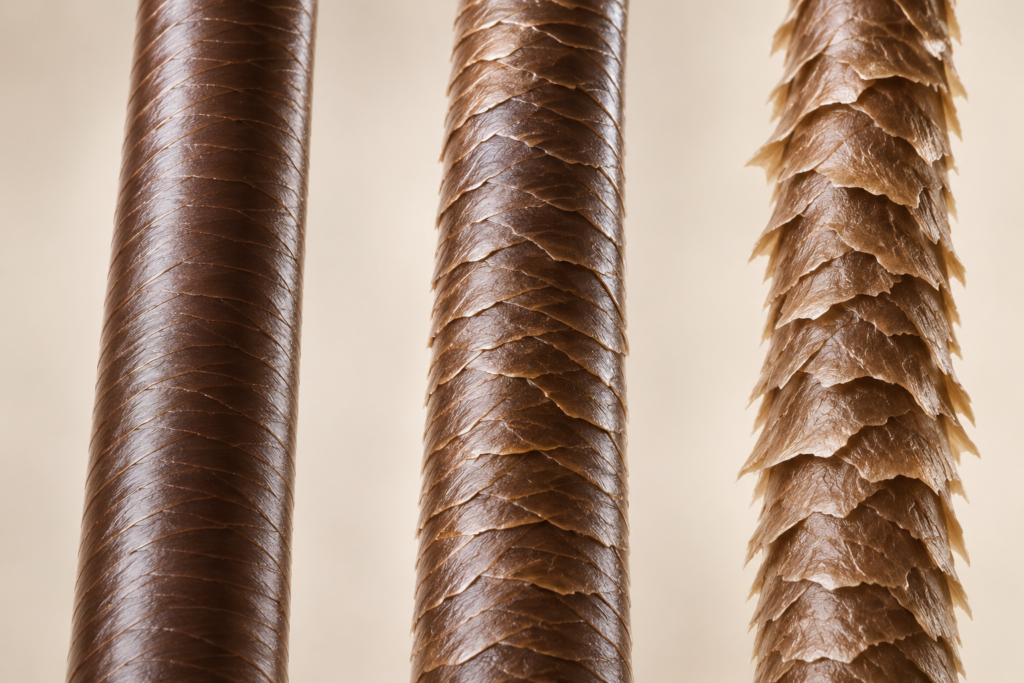
The outer surface of a hair strand is called the cuticle. When that surface is relatively smooth and intact, the strand behaves differently from hair with a rougher or more weathered cuticle.
Bleaching, coloring, repeated straightening, chemical treatments, excessive heat, mechanical wear, and everyday damage can make hair more vulnerable to breakage and frizz. Dermatologists specifically warn that frequent or excessive heat styling can leave hair brittle, frizzy, and lackluster.
More porous or damaged hair may also react more noticeably when environmental moisture changes.
That means two people can walk outside on the same humid morning and have completely different experiences.
Your reaction to humidity is partly about the weather and partly about the current condition and natural structure of your hair.
The Frizz Around Your Hairline May Have a Different Cause
There is another clue worth paying attention to: where the frizz appears first.
If your lengths remain relatively smooth but your temples, roots, and the area around your neck begin curling or puffing, humidity may not be acting alone.
You may simply be sweating.
The scalp, forehead, temples, and back of the neck are common places for heat and perspiration to affect a hairstyle. That small amount of moisture can be enough to alter the temporary shape created by a blowout or flat iron.
This is why a style may hold beautifully during winter but struggle on a warm subway platform, even when the forecast does not describe the weather as exceptionally humid.
For commuters, the indoor-outdoor cycle matters too. Walking from heat into powerful air conditioning and back outside again exposes hair to repeated changes in temperature and moisture.
Sometimes the enemy is not “bad weather.” It is your entire Tuesday morning commute.
Your Clothes and Commute Can Create Frizz Too
Environmental frizz is not always chemical. Some of it is mechanical.
Think about how many surfaces your hair touches after you leave home.
A wool coat collar.
A scarf.
The shoulder strap of your work bag.
The back of a rideshare seat.
Headphones.
A hood.
Your own hands as you repeatedly move your hair away from your face.
Friction can disturb the smooth alignment of the hair surface and contribute to flyaways and breakage, particularly if the hair is already dry or fragile. Rough towel drying and excessive brushing can also contribute to damage and frizz.
This is one reason your hair might look worse at the end of a dry, windy day even when humidity was relatively low.
If the underneath layers of your hair always look fuzzier than the top, look at what they are rubbing against throughout the day.
The answer may be your coat rather than your conditioner.
Why More Hair Oil Doesn’t Always Solve the Problem
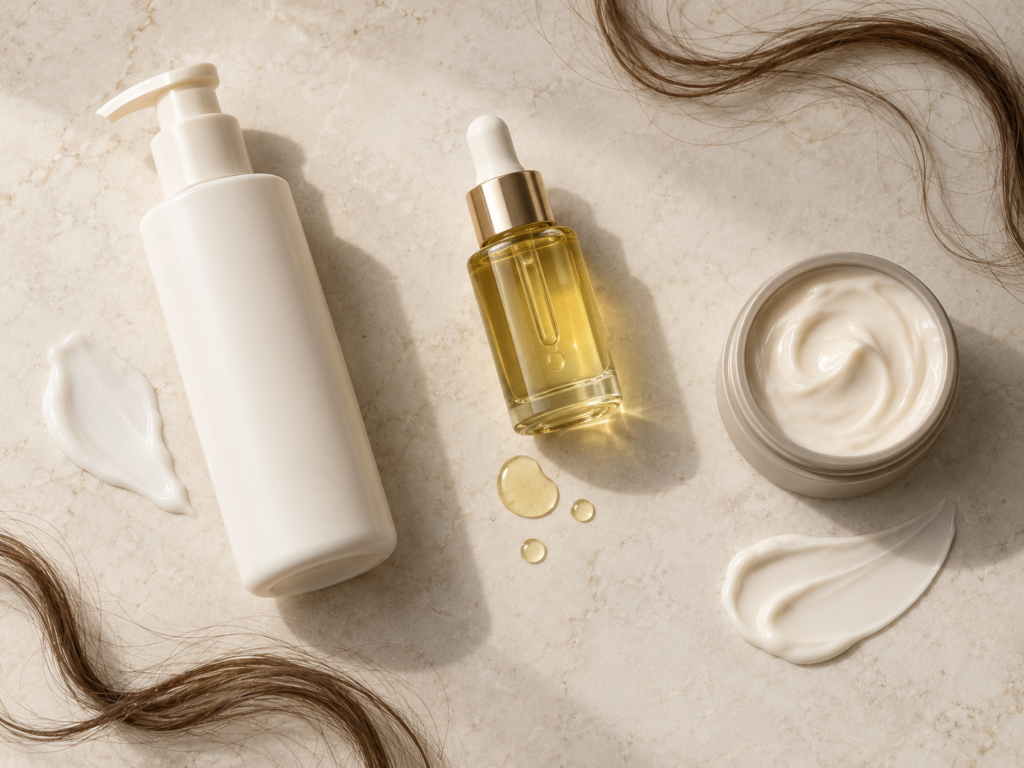
When frizz appears, many of us reach automatically for hair oil.
A small amount can certainly make rough ends look smoother and add shine. But piling oil onto frizzy hair does not necessarily address the reason the frizz developed.
It helps to separate four different jobs that often get grouped together as “moisture”:
Conditioning helps improve softness, manageability, and slip.
Hydration and water balance influence how the hair fiber behaves.
Smoothing products can help the surface of the hair look more uniform.
Styling products provide varying degrees of hold and help the hairstyle maintain its intended shape.
One product may perform more than one of these jobs, but they are not identical.
If your blowout collapses every time you encounter humid air, adding oil afterward may make the surface shinier without giving the hairstyle enough hold to resist environmental change.
And if you keep applying more, fine hair can quickly go from frizzy to flat and greasy without ever becoming particularly smooth.
Instead of asking, “What oil should I use?” a better question may be, “What part of my routine is failing when the environment changes?”
Why Your Blowout Gets Frizzy Even When You Did Everything “Right”
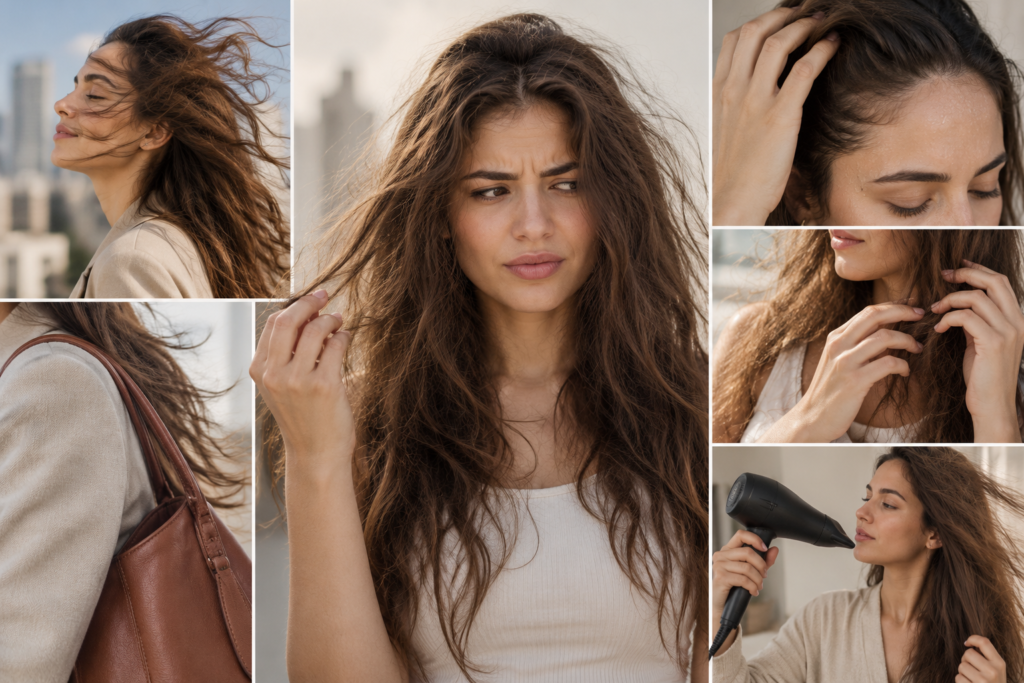
You washed carefully.
You conditioned.
You used heat protectant.
You sectioned the hair.
You dried every piece.
So why is it still frizzy?
One possibility is that the hairstyle was created successfully but not fully prepared for what came next.
A smooth indoor finish and a weather-resistant finish are not necessarily the same thing.
For example, repeatedly running a very hot flat iron over dry or damaged hair may create immediate smoothness, but using excessive heat can contribute to longer-term hair damage. The American Academy of Dermatology recommends using flat irons on dry hair at a low or medium setting and reducing excessive heat exposure.
That creates an important distinction:
More heat does not automatically equal more humidity resistance.
If your hair needs increasingly high temperatures just to appear smooth for a few hours, increasing the temperature again may not be the most useful long-term strategy.
The goal should be to create a routine that relies on hair condition, appropriate products, technique, and realistic styling expectations rather than simply more heat.
How to Keep Hair From Getting Frizzy When You Go Outside
There is no single routine that works for every texture, but a few principles can make outdoor frizz easier to manage.
1. Start With Conditioned Hair
Hair that feels consistently rough or dry may be more difficult to manage in changing weather.
Use a conditioner appropriate for your texture and concentrate it where your hair needs it most. Fine hair may need something lightweight, while coarse, curly, chemically treated, or very dry hair may benefit from richer conditioning.
Conditioner can help smooth the hair surface, reduce friction, and make detangling easier, although it cannot permanently repair an already damaged hair shaft.
2. Stop Roughing Up Wet Hair
Wet hair deserves gentler treatment than many routines give it.
Avoid aggressively rubbing your hair with a towel. The American Academy of Dermatology recommends gentler drying practices and minimizing unnecessary handling because wet hair can be vulnerable to breakage.
How you detangle should also reflect your texture. Curly and tightly textured hair often requires different handling from straight hair.
The goal is not to follow one universal rule. It is to reduce unnecessary friction.
3. Use Heat Strategically, Not Aggressively
If you blow-dry your hair, focus on technique before temperature.
Work in sections, allow excess water to leave the hair before applying prolonged heat, and avoid repeatedly passing hot tools over the same sections simply because the finish is not glass-smooth immediately.
When using a flat iron, start with the lowest temperature that effectively styles your hair rather than automatically choosing the highest setting.
4. Choose Styling Products for the Day You Are Actually Having
Your weather app may be more useful for your hair routine than another beauty tutorial.
If you know you will spend most of the day in humid weather, use styling products suited to maintaining shape and controlling frizz rather than relying solely on a lightweight finishing oil.
If you will mostly be in an air-conditioned office, your needs may be different.
Think about where your hair is going, not only how you want it to look when you leave the bathroom.
5. Let the Style Fully Set Before You Leave
One common mistake is styling until the last possible minute and immediately rushing outdoors.
If sections of hair are still warm or slightly damp when they encounter humid air, the style may change more quickly.
Give your hair time to cool and settle after heat styling before tying it up, touching it repeatedly, or walking into challenging weather.
6. Stop Constantly Touching It
This one is deceptively difficult.
You notice one flyaway, so you smooth it.
Then you check again.
You tuck the hair behind your ear.
Pull it forward.
Push it back.
Run your fingers through it on the train.
By lunchtime, the style has been manipulated dozens of times.
Hands add friction and can transfer oils or moisture. Once the hair is styled, try to leave it alone unless it genuinely needs adjusting.
Sometimes the Best Humidity Strategy Is to Stop Fighting Your Natural Texture

There is a cultural expectation behind a lot of frizz anxiety that rarely gets discussed.
Smooth hair is often treated as the default sign of being “put together,” particularly in professional or formal settings. A little texture, volume, or movement can therefore feel like a styling failure even when the hair itself is behaving normally.
That expectation can lead to increasingly elaborate routines designed to make naturally wavy or curly hair behave like a completely different texture in weather that actively encourages it to return to its original pattern.
Sometimes the most practical humid-weather strategy is not stronger control.
It is choosing a style that allows some movement.
That might mean leaning into your natural waves, choosing a softer blowout instead of pin-straight hair, wearing curls with definition rather than stretching them completely, or choosing an intentional updo on a day when the forecast is working against you.
There is a difference between managing frizz and demanding that your hair remain completely unchanged from 7 a.m. to 10 p.m.
For a real life that includes commuting, weather, workouts, dinner plans, and everything in between, flexibility can sometimes produce a better result than perfection.
How Do You Know Whether Your Hair Is Frizzy or Damaged?
Frizz alone does not necessarily mean your hair is unhealthy.
Naturally textured hair can have flyaways and volume while still being perfectly normal. Humidity can also change healthy hair temporarily.
Damage becomes more likely when frizz appears alongside signs such as frequent breakage, roughness, split ends, loss of elasticity, or hair that has been heavily exposed to bleach, chemical treatments, or repeated high heat.
A sudden major change in texture accompanied by significant shedding, patchy hair loss, scalp pain, itching, redness, or scaling deserves more attention. In those situations, a dermatologist can help determine whether something beyond routine cosmetic frizz is happening.
The Real Reason Your Hair Changes as Soon as You Leave Home
The mirror is not lying to you.
Your hair really did look smooth when you finished styling it.
What changed was the environment.
The moment you step outside, your hair starts interacting with moisture, wind, heat, perspiration, friction, and movement. Its response depends on its natural texture, porosity, condition, styling method, and the products you used.
That is why the most effective approach to frizz is rarely another desperate layer of oil or another pass with the flat iron.
Pay attention to the pattern instead.
Does your hair react mainly on humid days? Does the hairline change first? Does the underside get rough where it touches your coat? Is your frizz dramatically worse after coloring or bleaching? Does your blowout survive indoors but collapse during your commute?
Those details tell you far more than the word “frizz” alone.
Once you know what is disrupting your hairstyle, you can build a routine for the life you actually live, not just for the ten minutes you spend looking at it in the bathroom mirror.
Frequently Asked Questions
Why does my hair get frizzy as soon as I go outside?
Humidity is one of the most common reasons. Hair can absorb moisture from humid air, which can affect temporary bonds inside the hair fiber and cause strands to swell, bend, or move away from a smooth style. Wind, sweat, friction, and hair condition can make the effect more noticeable.
Why is my hair smooth indoors but frizzy outside?
Indoor environments are usually more controlled. Outdoors, your hair may encounter humidity, wind, heat, perspiration, and friction that were not present while you were styling it. The sudden environmental change can alter how the hair holds its shape.
Why does my straightened hair get frizzy in humidity?
Straightening temporarily changes the arrangement of weaker bonds within the hair. Moisture from humid air can interfere with that temporary shape, allowing the hair to move back toward its natural wave or curl pattern.
Does dry hair get frizzier in humidity?
Dry, porous, weathered, or chemically treated hair can be more reactive to environmental moisture because its outer surface may be less uniform. However, natural texture and the products used also influence how hair behaves.
How can I stop my hair from puffing up outside?
Start with consistent conditioning, reduce unnecessary heat and friction, use styling products suited to your texture and weather conditions, make sure the hair is fully dry and set before leaving, and avoid repeatedly touching it throughout the day. If completely smooth hair consistently fights your natural texture in humid weather, adapting the style itself may also be more practical.
Is frizzy hair a sign of damage?
Not necessarily. Healthy wavy, curly, and coily hair can naturally have frizz and flyaways. However, frizz combined with significant breakage, roughness, split ends, or repeated chemical and heat exposure may indicate that the hair fiber has experienced damage.