
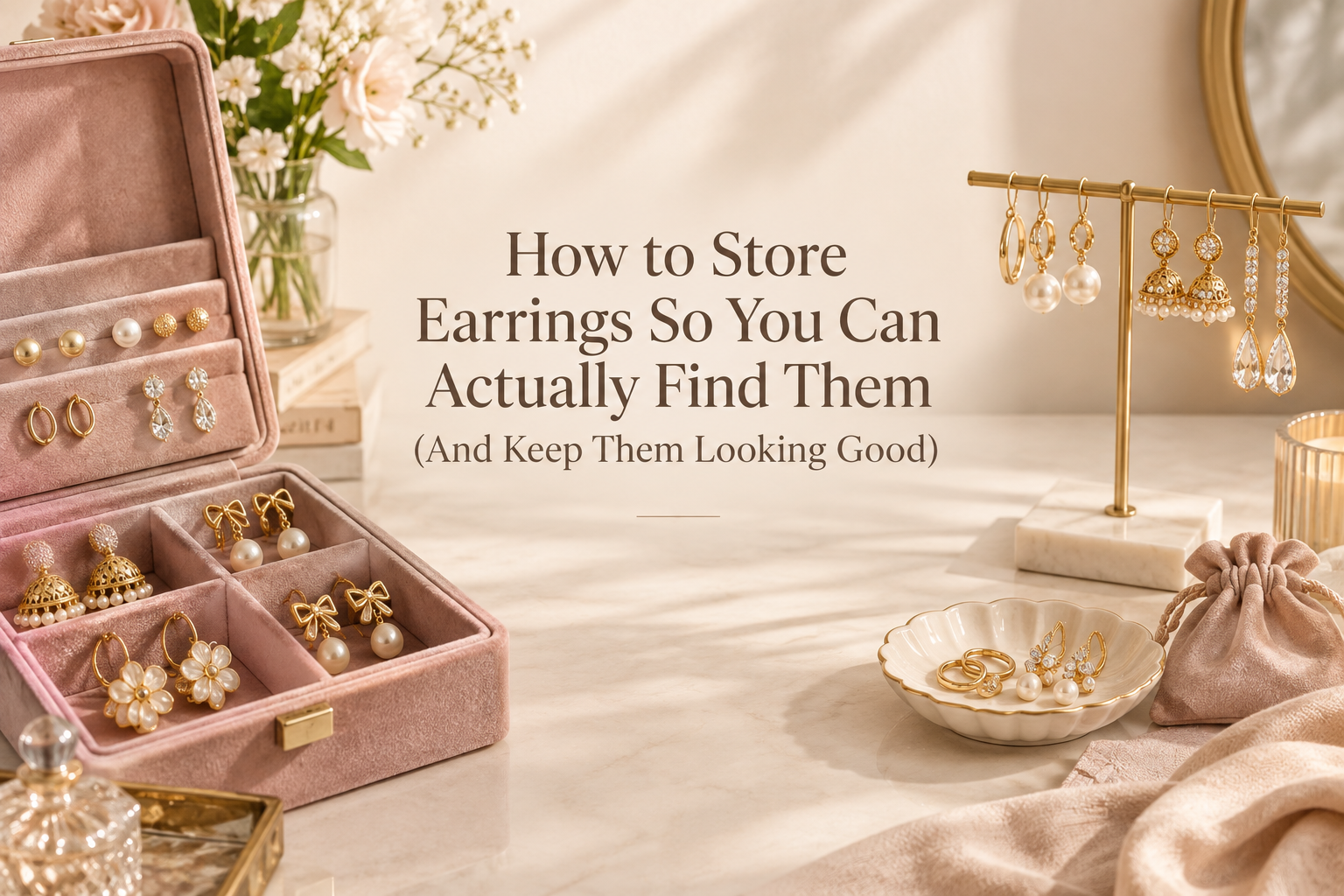
How to Store Earrings So You Can Actually Find Them (And Keep Them Looking Good)
You know you own the perfect pair of earrings for an outfit. The problem is finding both of them.
One stud is missing. Two hoops are tangled together. Your favorite jhumkas are somewhere underneath a pile of danglers. And the jewelry organizer you bought to fix the problem somehow became another place to hide things.
Learning how to store earrings isn’t really about making your vanity look Pinterest-perfect. A good storage system should keep pairs together, make the earrings you own easy to see and protect delicate pieces from unnecessary rubbing, tangling and moisture.
The trick? Don’t store every type of earring the same way.
Here’s a practical system that works for everything from tiny studs to statement jhumkas.
1. Store Stud Earrings in Small, Separate Slots
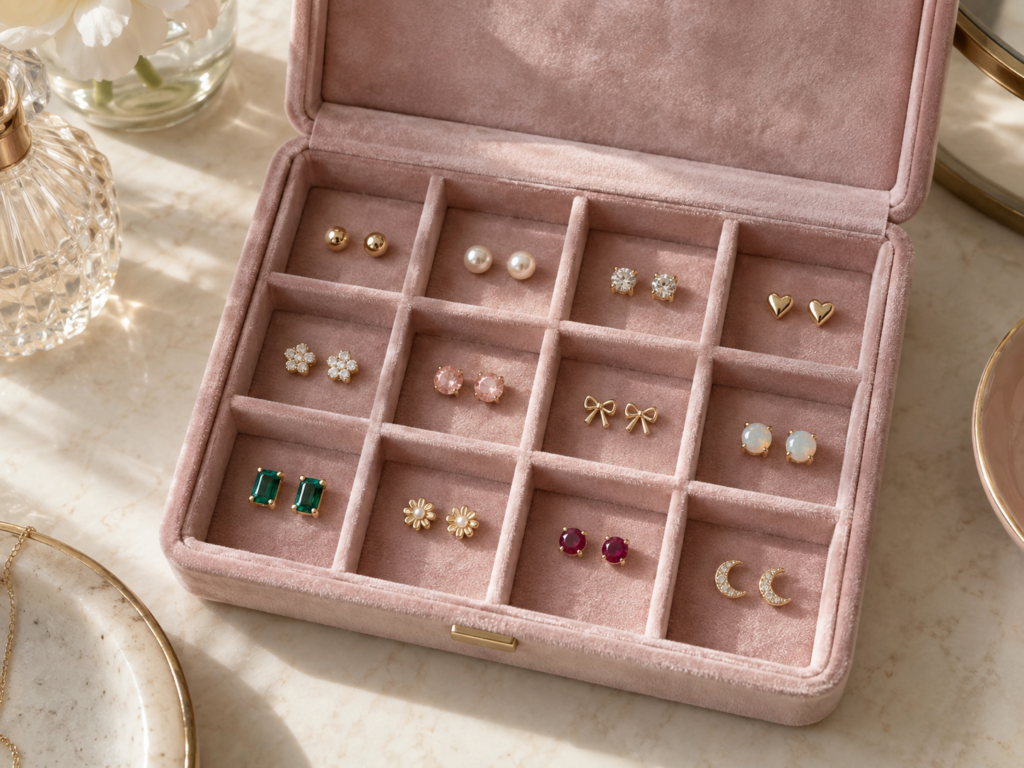
Studs are probably the easiest earrings to lose because they’re so small.
A divided earring organizer, pierced earring insert or jewelry box with small compartments works particularly well. Keep each pair together rather than dropping all your studs into one section.
For fine pieces such as gold earrings, diamond earrings or gemstone studs, individual compartments also reduce unnecessary contact with other jewelry.
If you own lots of studs, don’t waste a large drawer on them. Look for an organizer with many small sections instead.
Best storage: Small divided compartments or pierced inserts.
2. Give Hoops and Huggies More Room
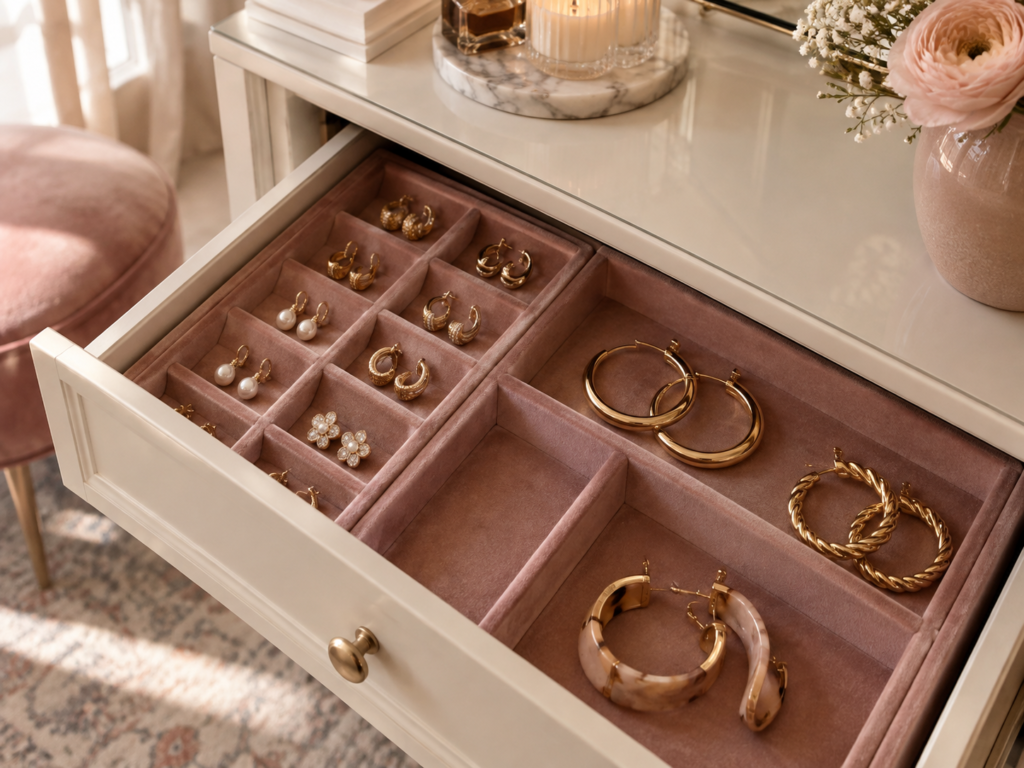
Hoops need a different setup.
Small huggies can sit neatly in individual compartments, while larger hoops need enough width that they aren’t forced underneath other earrings.
If you have several pairs of large hoops, a suitable earring stand can make them easier to see. However, valuable or tarnish-prone pieces may be better protected inside a closed jewelry box rather than permanently displayed.
The goal isn’t to fit as many earrings as possible into one compartment.
It’s to stop them becoming one giant metallic puzzle.
Best storage: Shallow compartments for huggies; wider sections or a suitable stand for larger hoops.
3. Let Long Drop and Dangle Earrings Hang
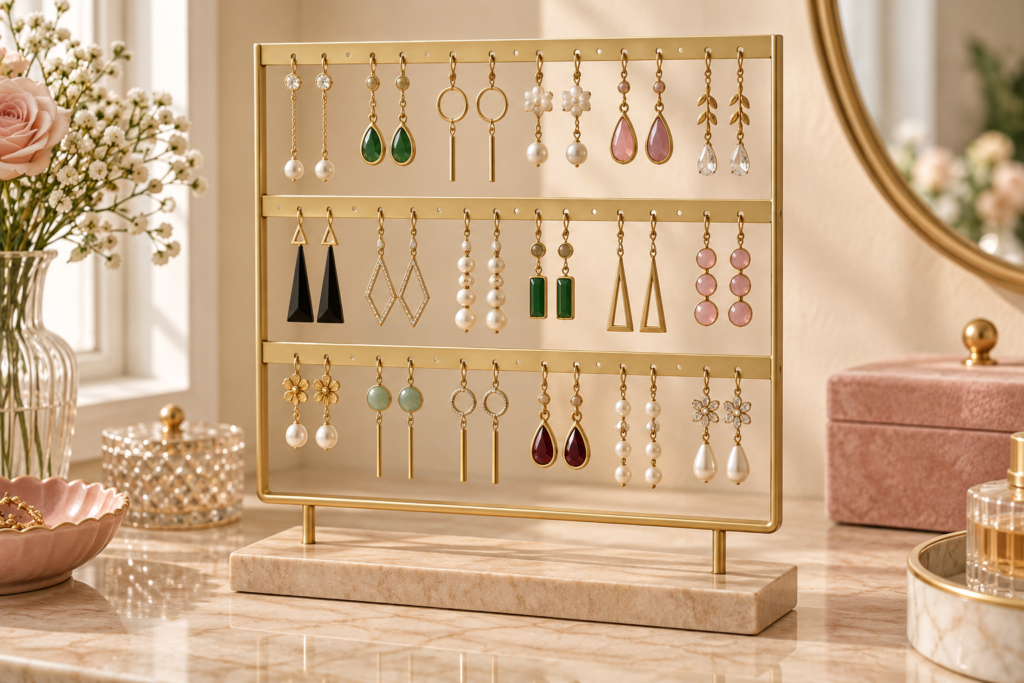
Long earrings are where tiny jewelry compartments stop being particularly useful.
If delicate danglers are piled together, hooks and chains can catch on neighboring pieces.
A vertical earring holder can work better because each pair gets its own space and hangs naturally. Choose one with enough distance between rows so the earrings don’t simply hang on top of each other.
If the earrings are particularly delicate or valuable, individual flat compartments may still be preferable to open display.
Best storage: Vertical organizer with enough clearance, or long individual compartments.
4. Don’t Squeeze Jhumkas Into Tiny Compartments
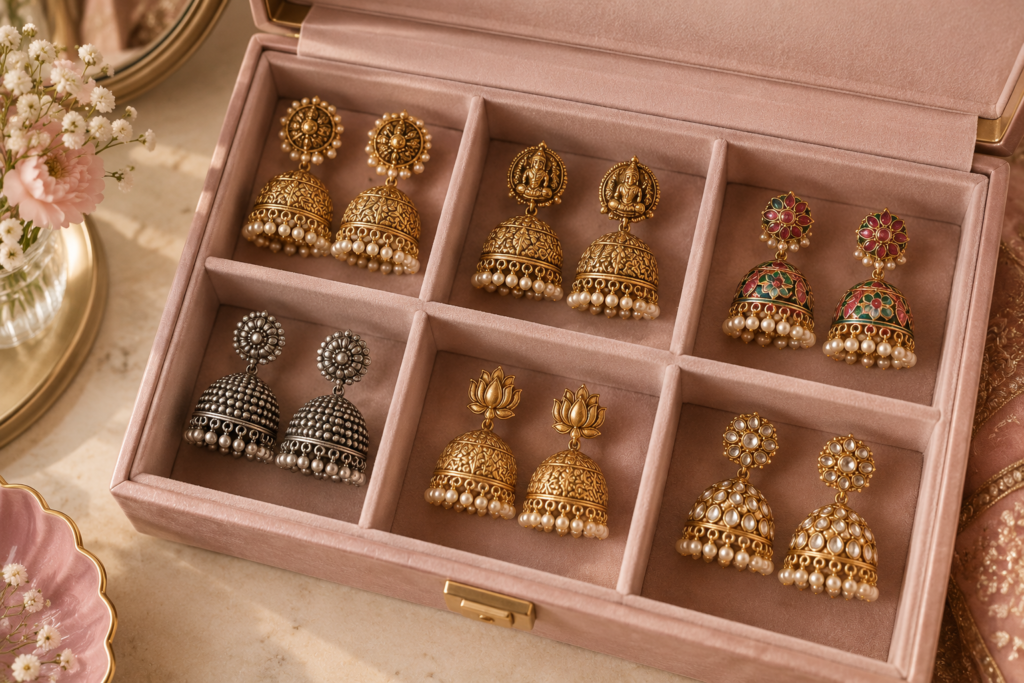
This is where many conventional earring storage ideas don’t work particularly well for Indian jewelry.
A jhumka isn’t shaped like a stud.
The dome needs space.
Instead of squeezing jhumkas into narrow slots, give each pair a deeper compartment where the decorative portion can sit without being crushed underneath other jewelry.
The same principle works for chandbalis and other dimensional Indian earrings.
For particularly ornate pieces, keeping pairs separately can also prevent hooks, beads and decorative elements from catching on one another.
Best storage: Deep, individual compartments with enough space around each pair.
5. Store Heavy Statement Earrings Flat
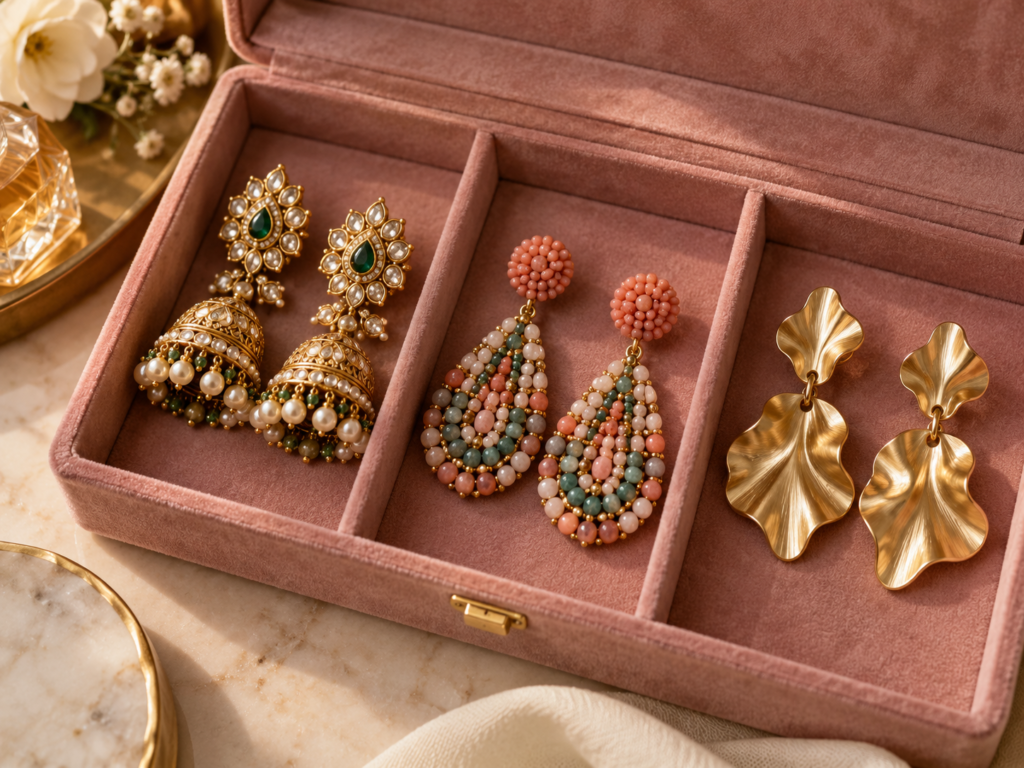
Large statement earrings may look beautiful hanging on a display, but weight matters.
For heavier pieces, I prefer a flat, padded compartment where the entire earring is supported rather than leaving its weight hanging from a delicate hook or decorative section.
Don’t stack several heavy earrings on top of each other either.
If your jewelry box has removable dividers, create larger spaces specifically for oversized pairs.
Best storage: Wide, padded individual compartments.
6. Keep Tarnish-Prone Earrings Clean, Dry and Protected
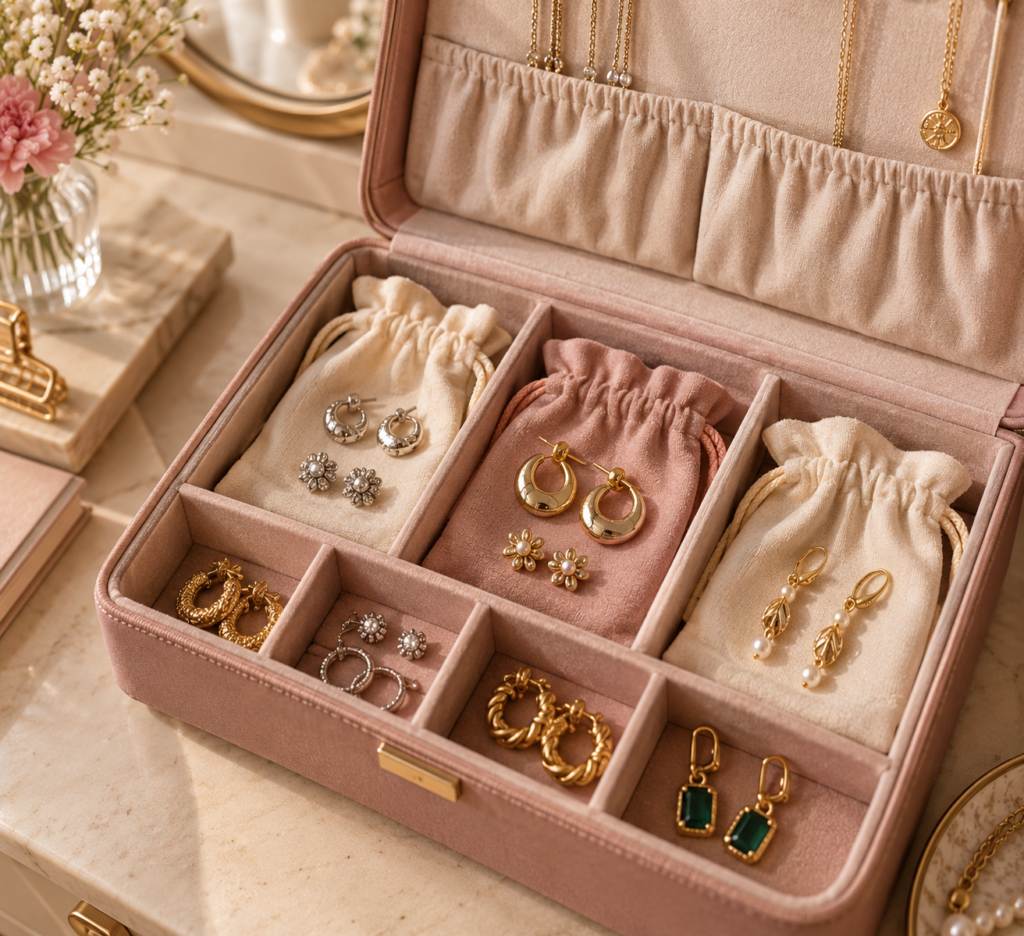
Not every pair should live on an open earring stand.
Tarnishing is influenced by exposure to moisture, air and environmental compounds. So, susceptible jewelry benefits from clean, dry storage. Jewelry-care guidance also commonly recommends storing pieces separately to reduce scratching and unnecessary contact.
If you own silver, plated or other pieces that tarnish easily, consider a closed organizer, suitable pouch or separate compartment rather than leaving everything exposed in a humid bathroom.
And yes, the bathroom may be convenient, but humidity and jewelry aren’t always great roommates.
Best storage: Clean, dry, enclosed and separated.
7. Create an “Everyday Earring Edit”
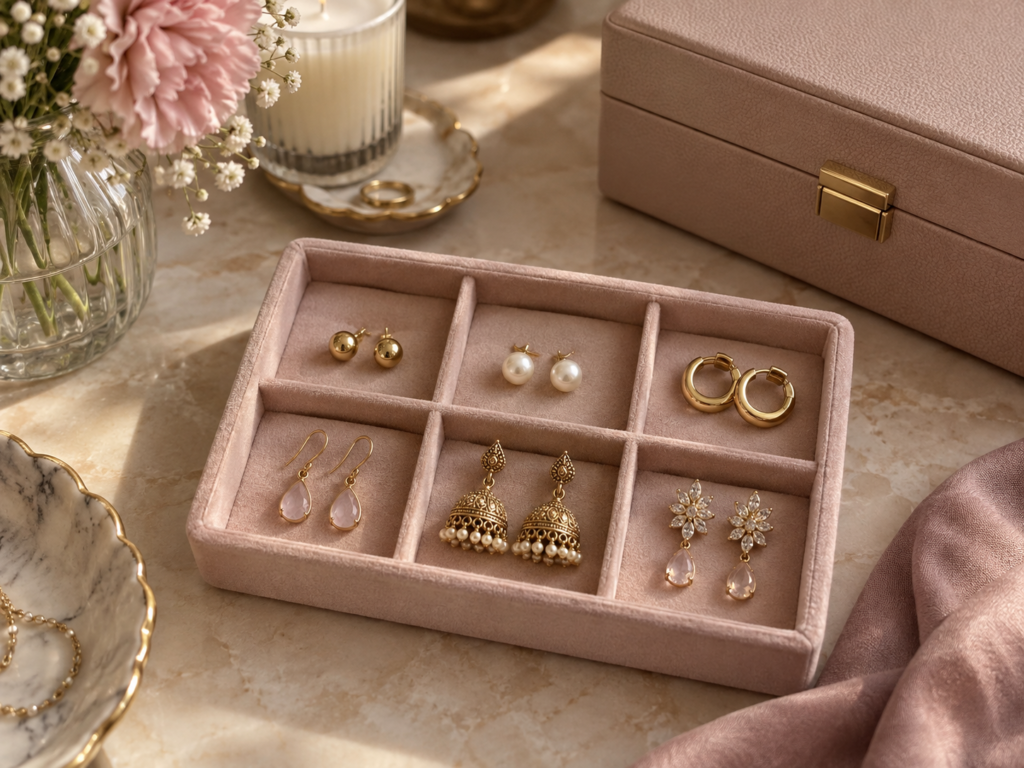
If you own 40 pairs but wear the same six constantly, don’t make yourself search through all 40 every morning.
Create a small Everyday Earring Edit.
Keep five to seven pairs you reach for regularly in a small accessible tray or organizer. Your main collection can remain properly stored elsewhere.
For example, yours might include:
a pair of everyday studs, small hoops, one simple drop earring, a neutral jhumka and one slightly dressier pair.
Rotate them whenever you feel bored.
This makes your collection easier to use without leaving everything scattered across the dressing table.
Best storage: Small accessible organizer for your current rotation.
8. Organize Your Jewelry Box by Earring Type
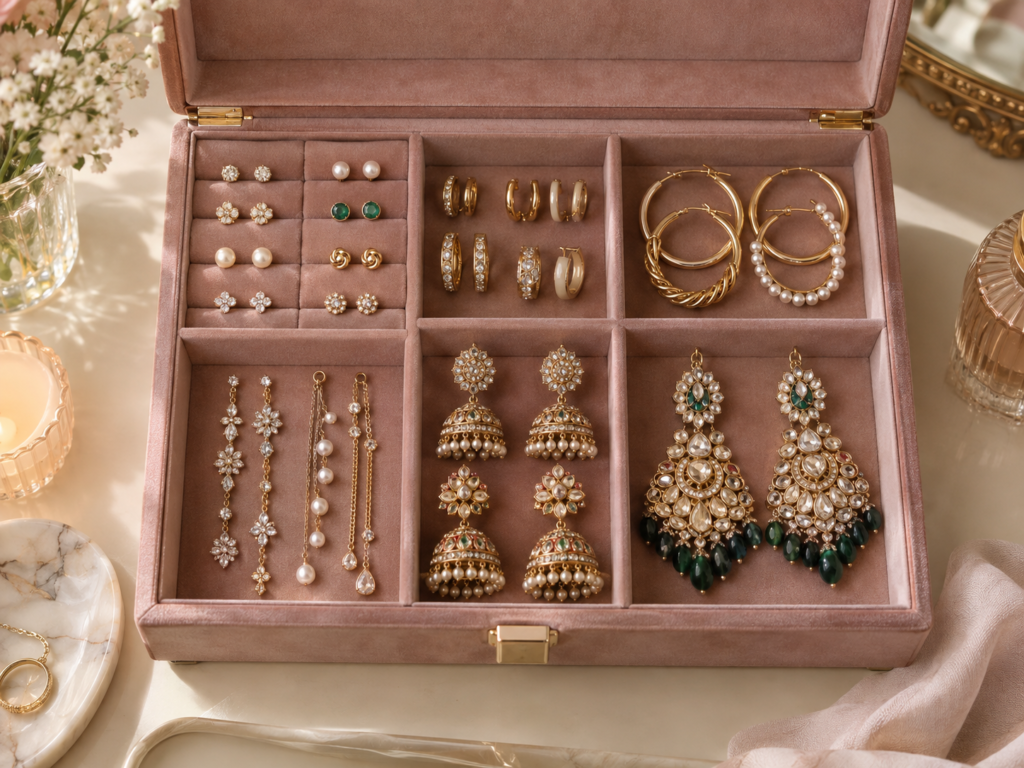
If you already own a jewelry box for women with multiple compartments, you probably don’t need another organizer.
You may just need to reorganize the one you have.
Rather than filling compartments randomly, create zones:
Studs → huggies → hoops → danglers → jhumkas → statement earrings.
Give small earrings smaller compartments and reserve deeper or wider sections for bulkier designs.
Once every type has a home, putting earrings away becomes much easier.
9. Don’t Keep Earrings You Never Wear in Your Prime Storage Space
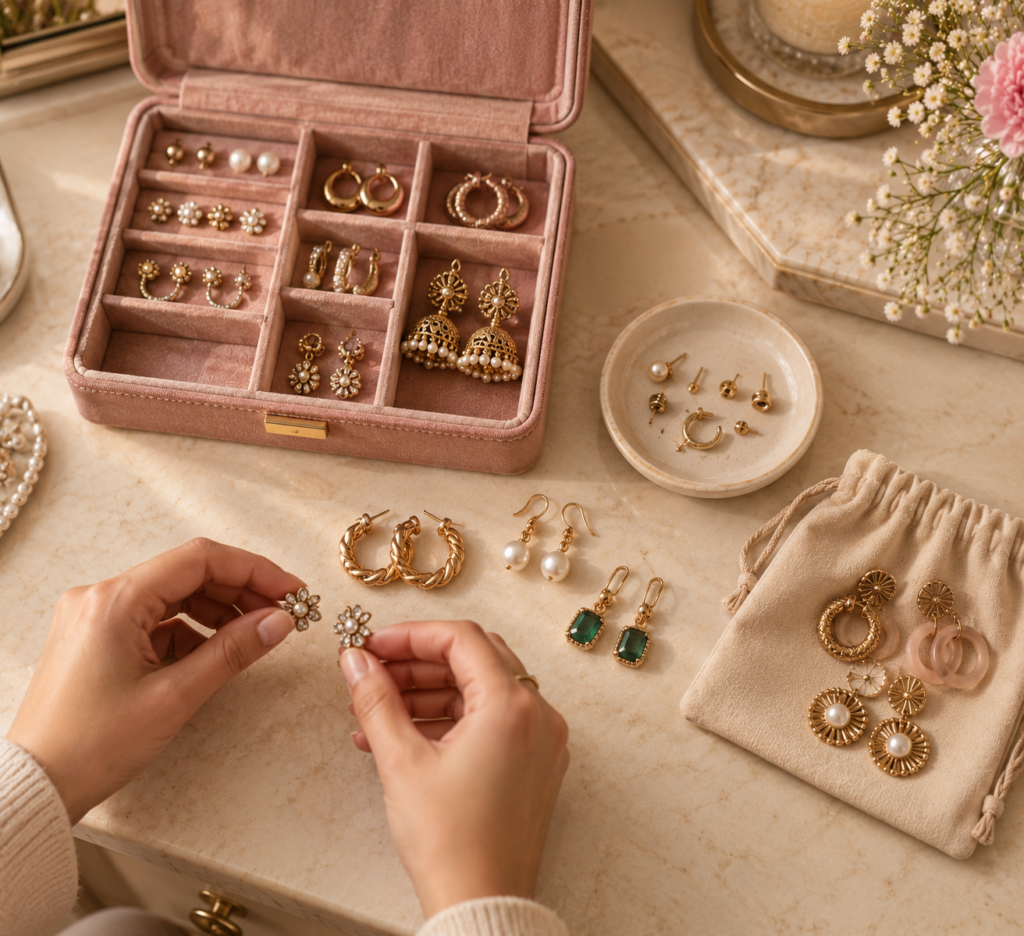
Organization gets much easier when you’re not organizing things you don’t actually want.
Every few months, look through your collection.
Are there earrings that hurt after ten minutes? A single earring whose partner disappeared years ago? Broken costume jewelry you keep meaning to repair? Pieces that simply aren’t your style anymore?
Repair what is worth repairing. Responsibly donate or pass along wearable pieces you no longer want where appropriate. Then give your prime storage space to earrings you actually wear.
Sometimes the best jewelry organizer isn’t a bigger one.
It’s a slightly smaller collection.
How to Organize Earrings in a Jewelry Box
If you want the simplest possible system, remember this:
Small earrings need separation. Long earrings need length. Bulky earrings need depth. Heavy earrings need support. Delicate earrings need protection.
Don’t choose a jewelry organizer simply because it looks pretty. Look at the earrings you actually own and choose compartments that suit their shapes.
A collection dominated by studs needs a completely different jewelry box from one filled with hoops, chandbalis and jhumkas.
FAQs About Storing Earrings
How do you store earrings without losing them?
Keep each pair together in an individual compartment, pierced insert or designated space rather than placing loose earrings in a shared tray. Always return them to the same place after wearing them.
Is it better to store earrings in a box or display them?
It depends on the earrings. Open displays make frequently worn pieces easy to see, while enclosed storage offers more protection from dust, moisture and unnecessary contact. Tarnish-prone or valuable earrings are generally better candidates for protected storage.
How should you store stud earrings?
Small divided compartments or pierced earring inserts work well because they keep each pair together without using unnecessary space.
How should you store jhumka earrings?
Give jhumkas deeper, wider compartments so the dome and decorative details aren’t compressed underneath other jewelry.
Can I keep earrings in the bathroom?
A dry bedroom or dressing area is generally a better storage location for jewelry that can be affected by moisture or tarnishing.
Final Thoughts
The best answer to how to store earrings isn’t one particular jewelry box.
It’s matching the storage to the earrings.
Give studs small compartments, hoops enough room, danglers enough length and jhumkas enough depth. Protect delicate pieces, and keep the earrings you wear constantly somewhere easy to reach.
Because a beautifully organized collection isn’t much use if you still can’t find the other earring when you’re already ten minutes late.